Yoga& information post
Yoga& the Climate Crisis
Why link yoga and the climate crisis
Yoga means union—the recognition that we are deeply interconnected with each other, with nature, and with all living beings. In a time of climate crisis, this understanding is more important than ever. The choices we make, the way we live, and the way we relate to the world around us all ripple outward. Yoga can help us meet this reality with both clarity and compassion.
For many of us, the climate crisis brings feelings of grief, fear, or helplessness. Yoga gives us tools to hold these emotions without becoming overwhelmed. Through breath, movement, and mindfulness, we learn to regulate our nervous systems, so we can stay grounded instead of shutting down. From that steadier place, we can act with purpose rather than panic.
Yoga, however, also tells us that it should be a priority for everyone to care for the planet and gives us the tools to internalise the deep interconnection with and compassion towards the external world. Yoga philosophy offers several guiding principles that speak directly to how we might meet the climate crisis. We can find anchors for internalising the ethics of living consciously, looking, for example, at the Yamas (focusing on how you show up in the world) :
Ahimsa (non-violence / non-harming) — choosing to live in ways that do no harm and further reduce harm to other beings and the planet.
Satya (truthfulness) — facing the reality of our situation honestly, while also seeking truth in how we respond.
Asteya (non-stealing and generosity) — embracing a sense of enoughness and not taking what does not belong to you, not to using more than your share of resources.
Brahmacharya (aligned use of energy) — channeling energy to a higher toward a higher purpose and to live a more conscious life.
Aparigraha (non-grasping) — letting go of overconsumption and freeing ourselves from greed and desire.
The role of workshops
In my workshops on yoga and the climate crisis, I bring these threads together. We use yoga practice not only to connect with our own bodies and breath, but also to explore how we relate to the world around us. The aim is to create spaces where we can process difficult emotions, reconnect with nature, and strengthen our resilience—so that we can keep caring, keep acting, and keep hoping.
Yoga doesn’t solve the climate crisis. But it can support us in meeting it - with steadiness, compassion, and a more profound sense of belonging - and to integrate changes in our own lives, with ripple effects to all sentient beings and the planet.
Yoga& the Nervous System
The role of the nervous system in yoga
Our nervous system is at the core of how we experience life. It shapes whether we feel safe or unsafe, connected or shut down, grounded or overwhelmed. In today’s world—with constant stimulation, stress, and uncertainty—many of us find ourselves bouncing between states of anxiety, exhaustion, and numbness.
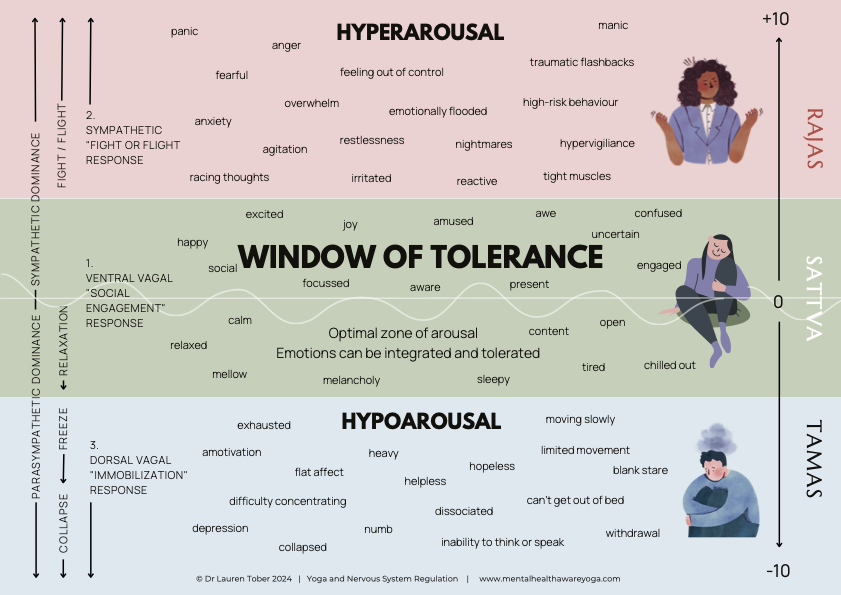
Yoga offers powerful tools to regulate and restore balance in the nervous system. Practices like mindful movement, yin and restorative yoga, breathwork, and meditation help us return to what’s often called the window of tolerance—that optimal zone where we can feel, think, and engage with life without tipping into fight-or-flight on one side, or collapse and shut down on the other.
Yoga and the polyvagal lens
Polyvagal theory describes three primary states of the nervous system, overall categorised as: social engagement (ventral vagal), fight-or-flight (sympathetic), and immobilisation (dorsal vagal). Yoga practices can support us in moving between these states with more ease—helping us downshift when we’re overstimulated, or gently reawaken when we feel flat and disconnected.
In yoga philosophy, we might see a parallel in the Guṇas (Sanskrit: गुण) (which refer to the three fundamental tendencies or forces that constitute nature): rajas (activation, energy), tamas (inertia, heaviness), and sattva (balance, clarity). Just as with the nervous system, the aim isn’t to eliminate any of these states, but to recognise them and cultivate balance—so we can live with more steadiness and presence.
Why Yin and Restorative yoga
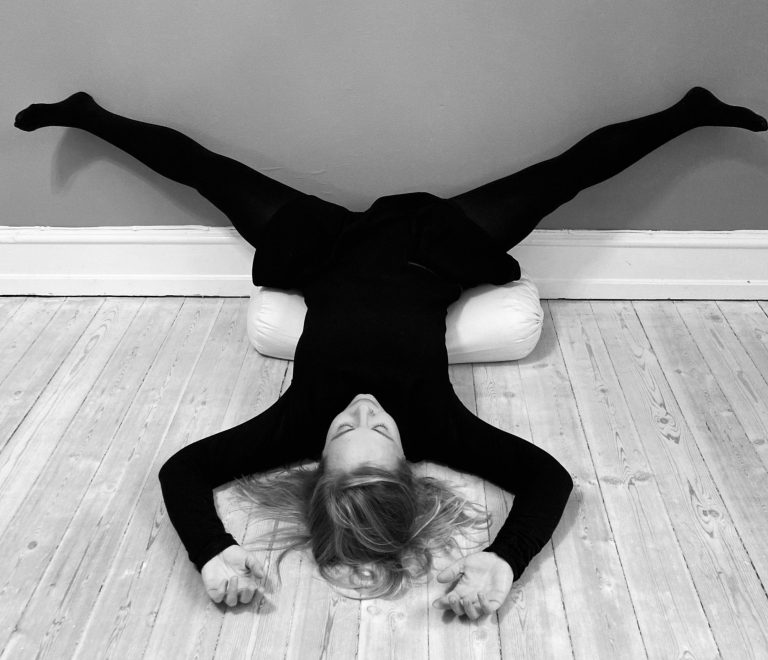
Yin and restorative practices are potent for nervous system regulation. Long-held, supported postures invite the body to soften, signalling safety and calm. This practice allows the parasympathetic system to activate—our natural “rest and digest” mode—where healing, repair, and deep rest can take place. These practices are medicine for stress, anxiety, burnout, and the constant busyness so many of us carry.
Integration into life
The benefits don’t end when we leave the mat. Learning to regulate the nervous system through yoga and small exercises that you can integrate into your day helps us in daily life: responding to stress with more choice, meeting anxiety with breath, and finding resilience when life feels overwhelming. In community, these practices also help us hold collective challenges—whether climate anxiety, social injustice, or uncertainty about the future—with more steadiness and compassion.
The role of workshops
In my workshops on yoga and the nervous system, I combine gentle practices with education. We explore the window of tolerance model, experience how different types of yoga affect our state, and learn practical tools for regulation that can be used in everyday life. I generally aim to practice sensitively, according to energies in the room; i.e., downregulating and upregulating depending on what people show up with.
Yoga can’t remove stress from the world. But it can change how we meet it—supporting us to stay more grounded, more connected, and more alive.
Yoga& Social Injustice
Why link yoga and social justice
Several core teachings of yoga, herein the Yamas and Niyamas (the first and second limbs of Patanjali's 8 Limbs of Yoga), speak directly to the work of social justice:
Ahimsa (non-violence/compassion) — extending care not only to ourselves, but to all beings, and resisting systems of harm.
Satya (truthfulness) — facing uncomfortable truths about inequality, privilege, and oppression, and speaking truth in the pursuit of justice.
Asteya (non-stealing/fairness) — recognising when we take up more than our share—whether in resources, power, or voice—and choosing to create space for others.
Tapas (discipline/heat /commitment) — Social justice requires sustained effort. Tapas gives us the inner fire to stay committed, even when the work is uncomfortable, slow, or exhausting. It reminds us that transformation—personal and collective—comes through showing up consistently.
Svādhyāya (self-study) — A central practice for justice work. It asks us to reflect on ourselves honestly: our privileges, our blind spots, the ways we benefit from or perpetuate inequities, so our actions are rooted in awareness rather than habit. Without this self-inquiry, social justice risks being superficial or performative.
Īśvara Praṇidhāna (surrender/devotion to something larger) — Injustice is vast, and none of us can fix it alone. Still, we can keep showing up with devotion to something larger than ourselves. This Niyama reminds us to act with devotion to the greater good while surrendering the need to control the outcome. It can bring humility and faith into justice work, helping us avoid burnout.
Furthermore, our Sangha (community) becomes a space to support us in understanding that transformation does not happen in isolation, but together, through solidarity and shared care.
The role of workshops
In my sharings on yoga and social justice, I invite participants to use practice as a way to explore these principles—not as abstract ideals, but as embodied tools for living. We reflect on how yoga can help us stay grounded when confronting injustice, soften our hearts when defensiveness arises, and inspire us to take action with clarity and courage.
Yoga alone cannot solve injustice. But it can strengthen our capacity to face it, to keep showing up, and to align our inner values with the world we want to create.
The Yamas and practicing yoga in a world that hurts
Dharma talk, Juli 2025
There's so much happening in the world right now that it's hard to hold. What's happening in Gaza is heartbreaking—there's a deep sense of injustice, grief, helplessness, and maybe anger when we're sitting far away, watching it unfold.
I'm reminded by one of my current favourite teachers, Susanna Barkataki, that we should engage in yoga for social justice.
We can use yoga philosophy as a reminder that yoga is not about turning away from the world.
The Yoga Sutras by Patanjali talk about the Yamas, one of the eight limbs of yoga. The Yamas are ethical guideposts for how you show up in the world. I want to mention two out of five of these:
Ahimsa is non-harm and non-violence.
Ahimsa is standing up against harm and injustice in all its forms, including taking direct action against injustices in a system that violently oppresses others.
Ahimsa is also about practicing compassion towards ourselves and others as we engage in the world.
Satya is truthfulness.
Satya reminds us that it's okay to name what's happening. And to feel the grief, the anger.
As we move and breathe together, let's make your practice a space to process. Not to fix or escape anything. Not to sit in the grief. But to reconnect with the strength we do have and your ability to stay present and compassionate.
I want to share a few selected practice affirmations from Susanna Barkataki's book "Ignite Your Yoga" related to the Yamas that you can read or repeat out loud to yourself:
You can set your intention for your yoga today, or feel free to use this one that I've set:
May our practice be dedicated to all those suffering, and to strengthening our own capacity to meet the world with care.
Yoga is not only a personal practice—it is also about how we live in relationship with others. At its heart, yoga means union: recognising that we are all interconnected. This understanding calls us to see how injustice, oppression, and inequality harm not only individuals, but the fabric of our shared humanity.
For many of us, engaging with social justice can bring up feelings of anger, grief, or even paralysis. Yoga offers tools to hold these emotions without being consumed by them. Through breath, movement, and self-awareness, we can steady ourselves so that we can act from compassion rather than reactivity.